Country Life

Country Life
Country Life 18x36 oil painting by Mary Mapes

Wednesday, May 11, 2011

1843 Railroad reaches Hillsdale


Reading Bank late 1800's

The "New"Reading Feed Mill 1912
    The first English-speaking white settler in what later would become the city of Hillsdale was Jeremiah Arnold, of De Peyster, New York, who arrived in 1834, pitched a tent and then built a log cabin on the site of the present day fairgrounds. In that same year, Chauncey Ferris and John Cook opened a well-stocked store in Jonesville. In 1835, the Jonesville Presbyterian Church was constructed, the first church building in the county. In 1839, the first newspaper, the Hillsdale County Gazette, was published on April 13, by James K. Kinman, an attorney and one of the early pioneers who credited Baw Beese for saving the lives of his sick family during a severe winter. The Whig-Standard, forerunner of The Hillsdale Daily News, did not appear in print until 1846. As an attorney, Kinman later gained fame as the defense council for the notorious international counterfitter, horse thief and outlaw Sile Doty, who was convicted in 1852 in the Hillsdale Circuit court and incarcerated throughout the Civil War in Jackson State Prison.
    After the railroad arrived to the county a line was sent to Reading and Montgomery.  Reading became a booming town with manufacturing -furniture, household necessities, buffalo tanning, folding chairs, etc.  proprietors built fancy homes as pictured in late 1800's.
    In 1843, the railroad reached Hillsdale from Adrian and the first steam engine of the Erie and Kalamazoo line rolled into the small village. For ten years thereafter, Hillsdale became the "jumping off place" for the wild west until the railroad was continued through to Coldwater and Chicago in 1853. Hillsdale was itself a little wild during that period as rogues and rascals took the trains to the last stop on the line. From that time until the 1950s Hillsdale was known as a railroad center, with as many as 26 passenger trains a day going in and out of the city.

Tuesday, May 10, 2011

Chief Baw Beese Potawatomies until 1840.

Chief Baw Beese
    Among the Indians reportedly never agreed to relinquish the land was Chief Baw Beese, a Huron-Potawatomi with a Scottish name for half-penny. Baw Beese, a council or peace chief, was one of the Indians of the so-called Huron-Potawatomi who had agreed to a treaty to relinquish land on the Huron and Raisin Rivers and to move west of line running straight north from the flagstaff of Fort Defiance, to a point on the Grand River-a line roughly marking the boundary between what now constitutes Hillsdale and Lenawee counties. In return for this the Baw Beese band was to receive $400 per year forever. The Moquago band at Nottawa Seepe (Near present day Athens, Michigan) was to receive a similar amount. Payments were made at Nottawa Seepe until the Baw Beese band was moved west. Thereafter, only the Moquago band received the payments, the last of which was made in 1910.
    Consequently, Chief Baw Beese considered himself a landlord and treated the early settlers as his guests, from whom he could and did demand rent. It has also been reported that he attempted to charge the settlers for the water flowing out of Baw Beese Lake.
    Historical research has revealed long-lost details about Baw Beese and his people. Those first settlers credited Baw Beese and his tribe of about 100 for helping their pioneer families by providing meat and traditional medicinal care through the long hard winters. The Potawatomies were known as successful planters and growers of maize (corn), who fished and hunted in fruitful locations. Baw Beese led his people around the county to three primary spots. The first was near the shores of Baw Beese Lake (supposedly named after the old chief by an early settler, Colonel William Fowler), where they fished; the second was near the corner of Squawfield and Waldron Roads, where they grew maize; and the third was just south of Somerset, where they hunted. The native inhabitants also made excursions into Ohio and Indiana, as well as into neighboring Michigan counties.
    Most Southern Michigan Indians had been relocted to reservations in Iowa and Kansas by 1838. However, because the majority of settlers in Hillsdale County admired and appreciated the local Indian population, Baw Beese and his people continued to co-exist with their white neighbors until the autumn of 1840. After one of the local pioneer`s wrote a letter to then President William H. Harrison requesting the removal of Baw Beese's people from the land he had rightfully purchased, federal troops were sent to roundup the "Red Men" to be escorted out of the county. It was a sad day when Baw Beese left. Schools were let out to bid the old chief and his people farewell. With Baw Beese driving a horse-drawn buggy in the lead, the federals took the Indians from the camp at Squawfield, through Jonesville and Litchfield to Marshall. From Marshall they went west, then down the Mississippi, up the Missouri River and eventually to a reservation at Council Bluffs, Iowa where Baw Beese feared his mortal enemy, the Sioux. Later, many members of the Hillsdale County band were relocated to the reservation north of Topeka, Kansas. Descendants of Baw Beese's village remained on that Kansas reservation throughout the 19th and 20th centuries. There is some historical evidence that some of the original inhabitants hid in the forests, or were hidden by settlers, and remained in the area. Other reports indicate that small groups of the Indians taken west returned to Hillsdale County and took up the ways of white men, eventually assimilating into the Euro- American culture.
    Even before the Indians departed, the first school in the county was opened in the tiny settlement of Allen by Hiram Hunt in 1831. A school was also opened in Jonesville in 1832 and was attended by the youngest son of Baw Beese. Jonesville later became the first organized school district in the state.

Monday, May 9, 2011

Spinning Wheels

Savanna Stripes- Zebra Colt
It seems like I have been busy all day but have accomplished little.  I mailed out the paintings to their new owners.  I had a new buyer from Western Australia.  All were little mini's 2.5x3.5inch, ACEOs, except for one an 11x14 of Mike Smith kissing Zenyatta GoodBye.  This week I have an 8x10 on stretched gallery wrap canvas up for auction on eBay.  Hope it sells well, starting at $25.oo no bids yet.  I really like it.

Sunday, May 8, 2011

Delving into history of our farm and the area.

I have been sidetracked for my art by life, my goal of sketching the wildflowers in the woods to a new study- that of studying the history of our area.  My son Mark found a book in his basement, since his house is about ten years old, the book probably belonged to his deceased father-in-law.  The book has its cover fallen off.  The book The History of Hillsdale County, Michigan published in 1879.  We read through parts of the book, Indian history etc. and paid special attention to the formation of our township.  My son Matt wondered if any of the people mentioned in the book were involved with the settling of our farm.  To answer this we got out our deed that has been searched and documented several times.  In it we did indeed find where our property was given by President Van Buren to officers for service in the US Army.  The dates of the presidential deeds are August 1836 and January 1837.  I went thru the deed and recorded the owners of both properties that in 1900 were combined.  We were delighted to find biographical sketches of some of Reading's prominent men and pioneers.and to find their names and wills, on our deed.
The Buffalo Tannery was begun in 1877 in Reading, becoming one of the largest of its kind in the world.  Once the slaughter of buffalo began in the west, their population quickly disappeared, putting an end to the once thriving industry. 


Reading MI main street 1906.  There was still a drug store with a soda fountain on the corner up until around 1968.  The building now houses an art studio.  All the buildings in this block are still in tack up to and including the building with the tower on it, which was our fire station until 30 or 40 years ago.  Between the fire station and the drug store where the white rounded windows shoot out on second story, was an opera house!

This Brick house located around the corner, was built around 1850 as was our home.  This illustration comes from the book History of Hillsdale County Michigan written in 1879.   I find it remarkable how the pioneers and settlers built distinguished homes, buildings in such a short time.  1836 first pioneers build log cabins, two years later they have a mill and start building more elaborate homes several like this one and ours are still standing.  Ours was built of hand-hewn hardwood local lumber on  a foundation of large stones. 

Friday, May 6, 2011

ACEO offered at eBay art auction May8-15 marysfineart

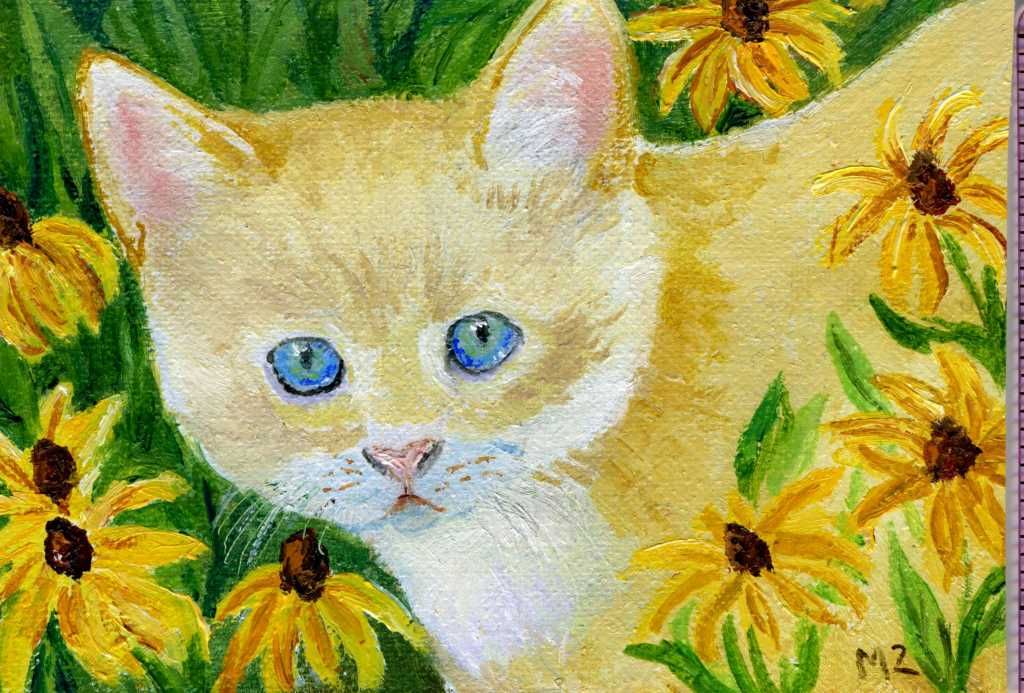
ACEO   Daisy  2.5"x3.5"
ACEO  Edge of Night

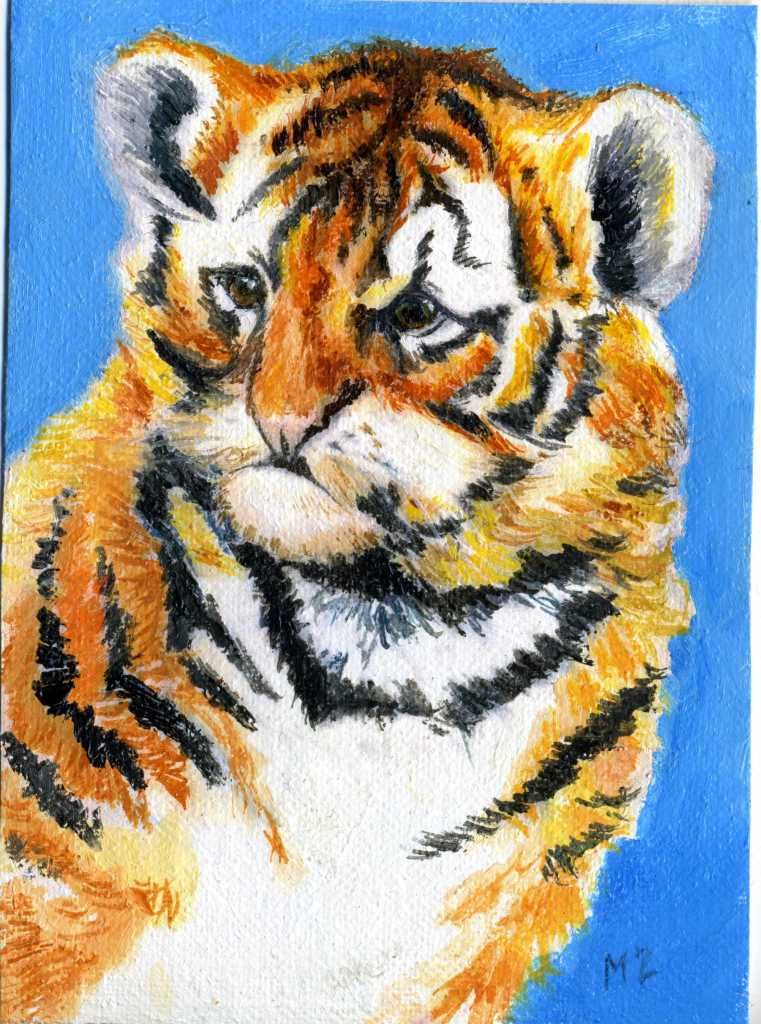
ACEO  Tiger Child

Wildflowers- Violets

I went on my daily ride and concentrated on the violets.  In our woods we have two violets: The Common Blue Violet and the Yellow Downy Violet.  The Common Blue are common in the spring in woods and around wooded area.  They are 3-5 in. high with 5 petals on the small flower.  Leaves are heart shaped with coarse round toothed margins.  The Downy Yellow violet are about the same size but yellow in color, they have brown-purple lines at their base of the center bearded petal.  In our woods the Common purple form many large bunches while the Downy yellow are fewer in smaller bunches.  I am seeing so many wildflowers and am getting behind in doing the portraits of the ones I can identify.  I tried to post my drawing but for some reason the blogger would not let me, so I am posting copyright free photos from the net.
View Image Smooth Yellow Violet

Thursday, May 5, 2011

"eBay" is a song by "Weird Al" Yankovic. It is a parody of "I Want It That Way" by Backstreet Boys. In it, the narrator describes how he incessantly purchases bizarre (and purportedly unneeded) items on eBay.  If you haven't heard the song go to Utube,  It is very humorous.
The song mentions many things either commonly found on eBay, or reflective of the ridiculous advertisements on the website.
My life on eBay may not be a comical but it is colorful for I sell miniature paintings called ACEO's
ACEO's are original pieces of art that measure 2.5 inches x 3.5 inches the same as a baseball card.  Collecting ACEOs is a way for a person to affordablely collect original artwork.  The little cards are used in a variety of ways from framing, gift inserts for cards to friend... to putting them in an album and everything in between.  They are a way a collector can have real, original art without breaking the bank.  Originally ACEOs were paintings that artist traded and shared among friends.  During the week I work at painting these little gems.  It takes me about 2-3 hours to do one as I am committed to presenting pieces with good composition that contain lots of detail.  Many of my ACEOs are oil paint on real canvas.  I post them on Sunday night and they auctioned on the site for 7 days.  I have not found a good way to direct people to my site.  My id name is marysfineart but I can't get to the site using that.  I put M2 at the end of most of my painting descriptions so that people can search for M2 and find my work.  I am told that M2 is on others but that you can check a few to find mine and then add my auction to eBay favorite sellers.  I will be posting some of my ACEOs on this blog.